
Granite vs. Quartz Countertops: A Complete Comparison for NJ Homeowners
“Which is better, granite or quartz?”
This is one of the most frequently asked questions that I get asked.
The answer to that depends largely on the end user. There are many benefits to both quartz and granite, and each have a few drawbacks as well.
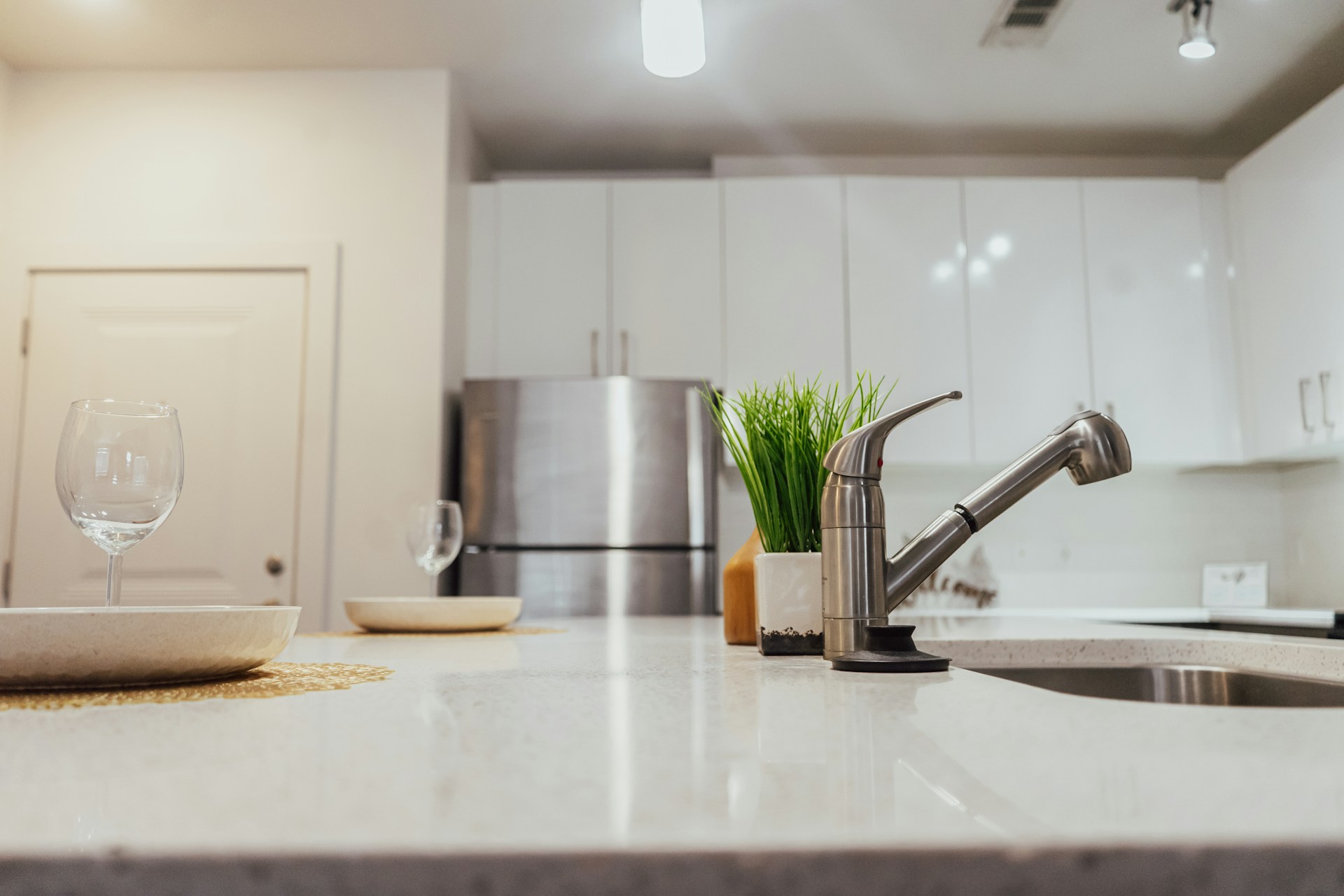
Quartz boasts a wide array of color options as well as solid colors. Quartz is also nonporous, which means that it’s more resistant to staining and harboring bacteria, which is especially important in kitchens. Therefore, quartz is essentially maintenance-free.
Granite does require sealing this sealing needed to be done at least annually, depending on how it is cleaned and with what type of cleaner. Bleach and alcohol based cleaners’ breakdown the sealers so if used will need to be sealed more frequently.
modern penetrating sealers for granite typically carry 10–15 year performance ratings when applied correctly though NJ’s hard water conditions accelerate sealer degradation and may require more frequent resealing in homes on well water.
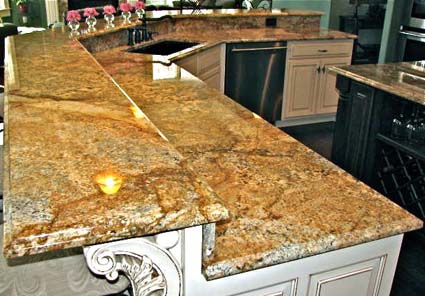
So, for all practical purposes, it’s maintenance-free as well. Granite has bragging rights because of its natural beauty. Since granite is a natural product, Mother Nature has bestowed upon it variations in color and pattern that cannot be manufactured.
We get asked the question, “How much less would it be if I went with quartz instead of granite”. The answer surprises many of our clients. Ten and even five years ago, granite was one of the priciest materials for kitchen countertops, but in recent years, pricing has been dropping to be the same as quartz, and in some cases, even less.
Why, then, would someone choose man made quartz when natural granite is comparable in price?
Quartz has the advantage of being more stain resistant than granite, even with the new sealant technologies out there. For a small space, quartz is great because it results in a more even look, whereas granite shines when it’s used for a massive expanse, such as a large kitchen island.
Your preference in style plays a major role, Quartz tends to have a cleaner, more contemporary look because of the coloration of it, and granite yields more of a traditional and timeless appearance.
In NJ’s Morris and Union County market, quartz has become the dominant countertop specification for kitchen remodels in the $80,000–$130,000 range chosen primarily for its consistency of appearance and low maintenance. Granite is specified more frequently in higher-budget remodels where the natural stone variation is a desired aesthetic quality rather than a variable to be managed.
Quartz vs. Granite: Stone or Not?
If your only concern is whether or not your counters are 100% stone, this is pretty much a tie. Granite can come in the engineered stone version, but quartz is always engineered. What does “engineered” mean?
Prominent quartz countertop maker CaesarStone notes that 93% natural quartz aggregates are mixed with the remaining 7% of color pigments and polymer resins. The resins are there to bind the particles together. Engineered granite is made in much the same way. However, since a 100% version of granite (slab granite) is available, the balance shifts to granite.
Quartz vs. Granite: Cost
Prices of quartz and granite countertops are continually shifting, depending on the availability of the source product. Not only that, costs vary according to manufacturer, installer, homeowner’s location, and so on. The moment you think you have a handle on the price of quartz and granite countertops, the price changes. In NJ’s 2026 market, installed countertop pricing for both materials typically ranges from $80–$160 per square foot depending on slab source, edge profile, and fabrication complexity. Premium granite slabs with significant movement or exotic origins run $120–$200+ per square foot installed. Mid-range quartz from major manufacturers (Caesarstone, Cambria, Silestone) typically falls between $80–$130 per square foot installed. The price differential between comparable quality granite and quartz has effectively closed homeowners are generally choosing between the two on performance and aesthetic grounds, not on cost.
Quartz vs. Granite: Durability
Natural, slab granite, for all its beauty, has flaws and imperfections that homeowners either love, accept, or hate. But engineered granite has the flaws engineered out (quartz, too). In these two products, you will not find invisible striations just waiting to crack open some day, as you will find with slab granite.
So in the end, it all boils down to what you like. If you’re looking for an old-world Tuscan kitchen and don’t mind a bit of maintenance, granite is the answer, but if sleek and modern is what you crave, then quartz could be the clear choice.
In NJ homes on well water or in municipalities with harder water common throughout Morris, Somerset, and Sussex County the mineral deposits from hard water affect surface appearance differently across materials. Quartz’s non-porous surface makes it easier to remove hard water residue without chemical stripping. Granite’s sealed surface can develop mineral buildup in the grout lines around the sink area that requires more aggressive maintenance. This is worth factoring into the decision for NJ households where hard water is a daily reality.
Ggranite vs Quartz vs Marble: The Third Option Most NJ Homeowners Don’t Consider
The comparison between granite and quartz leaves out a material that KraftMaster is specifying with increasing frequency in NJ’s higher-budget kitchen remodels: quartzite. Quartzite is a natural stone (metamorphosed sandstone) that is frequently confused with quartz engineered stone but is not the same material. Quartzite is harder than granite, more heat-resistant than engineered quartz, and achieves the dramatic marble-like veining appearance that quartz manufacturers have been attempting to replicate with engineered products. It requires sealing (like granite) but performs better than marble under acid exposure. For NJ homeowners who want the visual drama of marble with a more durable natural stone, quartzite is the material worth evaluating alongside granite and quartz. KraftMaster specifies quartzite on island countertops specifically, where both visual impact and durability are priorities.